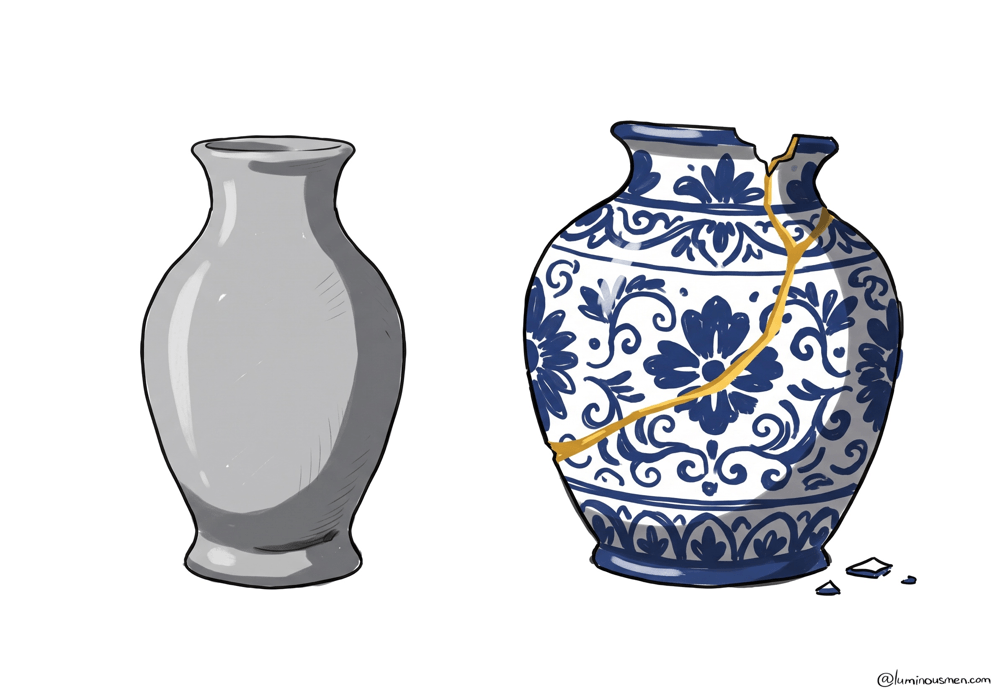
I look at technically perfect AI art and feel nothing. Zero. A flawless generated landscape moves me about as much as a screensaver.
For a while I told myself that that was my humanity talking, some deep circuit that can smell the absence of a soul on the other side. It's a nice story, and I believed it for some time, right up until I learned it's wrong and there are brain scans to prove it.
What I'm reacting to isn't the art. It's a sticker, a little label that says a human made this, and it's the cheapest thing in the world to fake.
This started on the podcast. The host, Joe, asked me the same question you've likely heard hundreds of times at this point: whether AI is going to replace people like me. Instead of, "well, it depends", this time I said that AI raises the floor and the ceiling at the same time, and we moved on. That sentence sat in my head for a week. This post is my attempt at unpacking those thoughts, and that process took me somewhere far less comforting than I expected.
The Floor is the Boring Part
The junior who couldn't write a window function last month now ships one that works. The blank page is gone. And the technician who takes a ticket, writes the pipeline, closes the ticket and never asks why it was created in the first place, that job is now a commodity. If your job can be replaced by an agent, you were probably miscast to begin with. I already wrote that whole post. Everyone agrees that the floor has moved up and it's the least interesting thing about this moment.
The ceiling is what's really worth examining, and it's got nothing to do with code. It's about presence, whether there's a real person on the other end, and whether you as the consumer of that work can feel it.
I want to believe you can. I bet you want to believe it too. I cringe when I see myself on a screen talking. I applaud at Cirque du Soleil. In both instances, I am reacting to a real person doing a real thing. Play me a rough recording of an actual human, out of tune, badly mixed, recorded on a phone in a kitchen, with the video freezing every few seconds, and it will still make me feel something. Despite being worse by every measurable spec than polished generated output, it will still touch something in me. Some potentially ancient part of the brain, the mirror neurons, empathy, whatever that wiring is called, it leans toward the human on the other end. It can't relate to the machine. There's nobody there to relate to.
The above sentiment sounds lovely, and in these strange times I bet it feels comforting. Unfortunately, it's wrong because of one inconvenient fact: people cry at AI songs.
Last summer a band called The Velvet Sundown pulled 1.4 million monthly listeners on Spotify, and people felt real things, right up until it came out that nobody was in the band. It was Suno, generated end to end, and when it got caught it described itself as "a synthetic music project guided by human creative direction". Same notes. Same ears. Same tears, right up until the label flipped. The only thing that changed was a sticker.
It's deeper than opinion. There are studies where the only variable is the label. Given an identical image, one group is told a human made it, the other a machine. The machine group unanimously rates it lower, feels less from it, and attributes less meaning to it. As expected, but it doesn't stop at judgment. It reaches down into perception: told it's AI, people see the same image as less vivid, and less colorful. Brain scans back it up. The label doesn't just change your opinion of the picture. It changes the picture itself.
So I have to ask an uncomfortable question about my own reaction. When the rough human recording moves me and the perfect machine one doesn't, am I responding to the sound, or to the sticker?
Honestly? Mostly the sticker. My empathy doesn't detect humanity. It responds to being told about humanity. Change only the label and my feeling flips, same as everyone in those studies. That's not a soul detector. That's a sticker detector.
The Sticker is Already Being Faked
That should bother you, because a sticker is easy to fake, and this isn't a someday problem you can put off worrying about. Anyone can make one. Today.
The Velvet Sundown already showed you the move. Caught red-handed, it reached straight for "human creative direction" as a shield. A new sticker placed over the old one as armor. Meanwhile a whole industry is booting up to sell the sticker directly. The Authors Guild has a "Human Authored" certification. There are "Not by AI" badges you earn by self-certifying that 90% of your work is human, which is exactly as rigorous as it sounds. Verification startups are stamping "Proudly Human" seals on things. Instagram's own head has admitted they can't reliably catch the fakes, so the new plan is to fingerprint the real stuff instead, and the detectors meant to police any of this are losing the arms race — the engines improve faster than the tools chasing them.
Now comes the part no one is saying out loud: sale of the human premium is actually what is paying for the fakes. The more selling a "made by a real person" sticker pays, the harder every machine on earth works to sound like one. Performed vulnerability. Engineered roughness. Manufactured seams. Three out of four new web pages already have a machine's fingerprints on them somewhere, and the next wave won't read as machine at all. It'll read as strategically human. AI raising the ceiling doesn't just threaten the technician. It kicks off an arms race in fake presence, fake humanness, fake being-there. And a lot of it is going to be very, very convincing.
What Will Survive
So the feeling isn't the moat. A machine can trigger it, in the case of The Velvet Underground, you just watched it happen to millions of people at once. What's actually hard to fake is the label being true, and staying true over time, out in the open, across everything you've ever made.
Anyone can fake being real for one post. Faking it for years, while people dig through your back catalog, your history, catch you contradicting yourself, watch you being dumb, check whether you still believe in public what you claimed three years ago, that's expensive. Not impossible, but expensive, and exhausting in a way that just being yourself isn't. It's a weaker kind of safety than "humans can't be replaced". But it's real, and I'd rather hand you the small true comfort than a big fake one. The moat was never "authenticity" or the feeling you could produce in someone with your work. It's the track record they can audit later.
Why the Podcast Couldn't be a Blog Post
The podcast itself turned out to be the cleanest example I have, and I only noticed while it was happening.
Two people, talking, unscripted, in real time. Could a model generate a transcript that reads smoother than ours? Easily. Mine's full of "like" and half-finished sentences and me apologizing for my English, which, note to self, stop doing that. A model would clean all of it up and be more articulate than either of us. Better by every spec. And, for now, dead on arrival, because nobody wants to listen to two language models agree with each other for forty minutes once they know that's what it is. The whole value was two actual humans thinking out loud and occasionally saying something we hadn't decided to say in advance. The friction is the product. The imperfection is the proof that a person is really there, improvising, at risk of saying something dumb. Sand it smooth and you sand off the exact thing worth listening to.
I say "for now" on purpose. The machines will get better at faking this too, and I don't have a clean answer for what to do on the day that they do. I only know it hasn't come yet, which is the theme of this whole piece: the parts of your work you were quietly embarrassed by, the roughness, the seams where your humanity shows through, those are the parts with a future. The polish is now free. The seams are not. Until the seams are faked too.
Where the Value Went at Work
Take tutorial content. I wrote a lot of it, and some of my most-read posts are "Here's How Spark Does X". I can feel that type of writing getting less interesting over time, mine included. Not because it's wrong, but because you can now ask a model "how does Spark do X" and get a decent answer in seconds, probably built on my own posts and those like it behind the curtain. The explanation stopped being the scarce thing.
What's still scarce is what actually happens when you run it in production. The bug that ate an entire week. The call you got wrong and had to live with going forward. The opinion you're a little scared to publish under your real name. Distilled experiences, not compiled knowledge — I've made this case before [LINK]. The value was never the output. It was the person and the thinking that produced it.
It's the same story at work. Let the machine take the boring mechanical parts, that's what it's for. Then spend the reclaimed hours on the things it can't touch: working out why the business actually wants the thing, having an opinion on whether it should be built at all, being the one holding the bag when it breaks. A model has no skin. It feels nothing when the pipeline drops production data. You do. That fear isn't a weakness. It's one of the last things that can't be faked into existence. At least, not yet.
To Sum Things Up
I'm not going to sell you a survival plan. No "do these five things and AI won't replace you" guide. I don't know if any of that is true, and I don't trust the people who say it is. Every previous wave had people swearing machines could never replace the human touch. They were right about the touch. They got replaced anyway.
What I've got to give you is smaller and less certain than when I started writing, which is usually a sign that I'm being honest. My gut says the present human still matters. My head says my gut mostly reacts to a label, and labels are cheap to fake. Both are true, and I'm not going to pretend the warm one wins.
So this is the most I'll commit to. In a world about to drown in perfect, frictionless, empty content, a person who's actually there, and who's been there long enough that faking it would have cost more than meaning it, is a little rarer than they were a year ago. That's it. Not safer. Just rarer.
The floor is a commodity. The ceiling turned out not to be talent, or polish, or even feeling, but really being there, and meaning it long enough that nobody can fake being you.